Hiring
Shortlisting Hundreds of Applicants Without Reading Every Resume
Set the pass mark before you read anyone, let each stage drop people on evidence, and save your own time for the final names and their answers.
Author
Xquizit
Reading time
3 min read

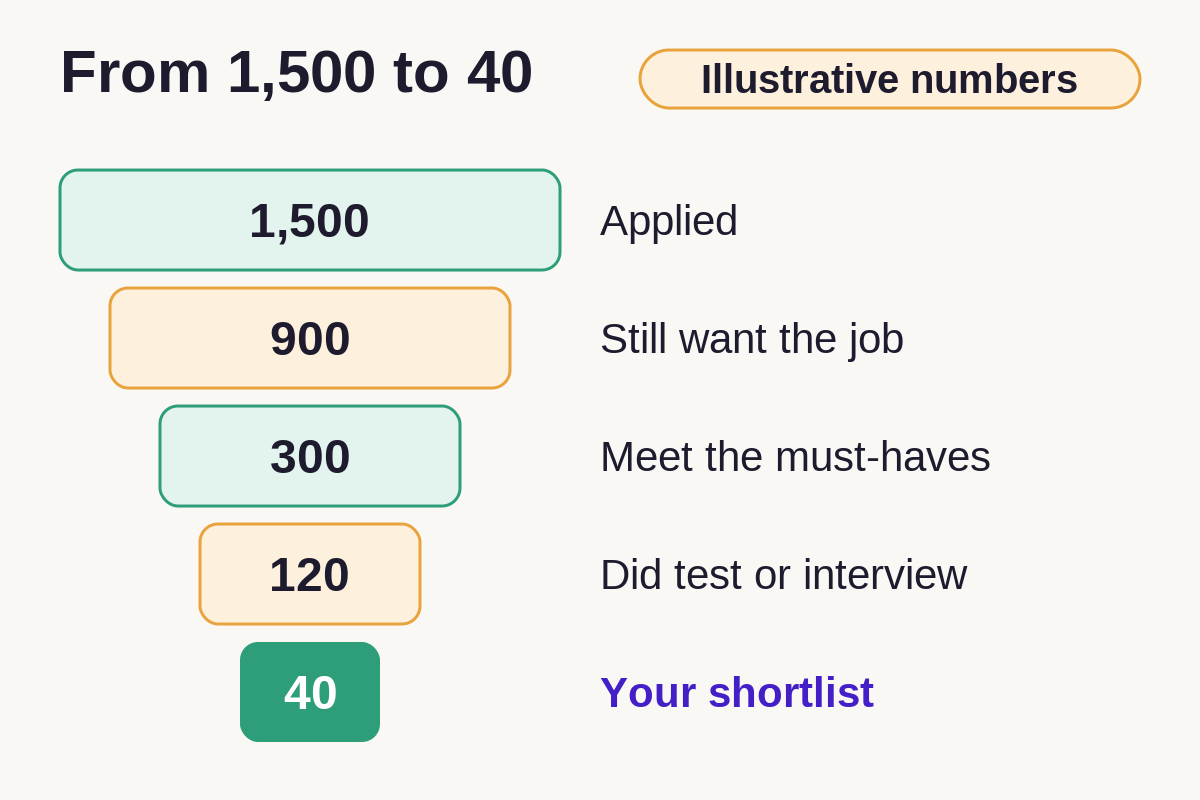
Take an illustrative case. You have 1,500 applications for 40 customer support seats, and the hiring manager wants a shortlist by Friday. You can't read 1,500 resumes by then, and a keyword filter feels like a coin toss. So how do you shortlist without guessing?
High-volume hiring · illustrative scenarioWrite the pass mark before you open a resume
Decide what passes, then sort the criteria.
Decide what passes before you read anyone, then let each stage drop people on the evidence they give you. I'd let AI read the resumes and run the first conversation, and keep the final shortlist a person's call.
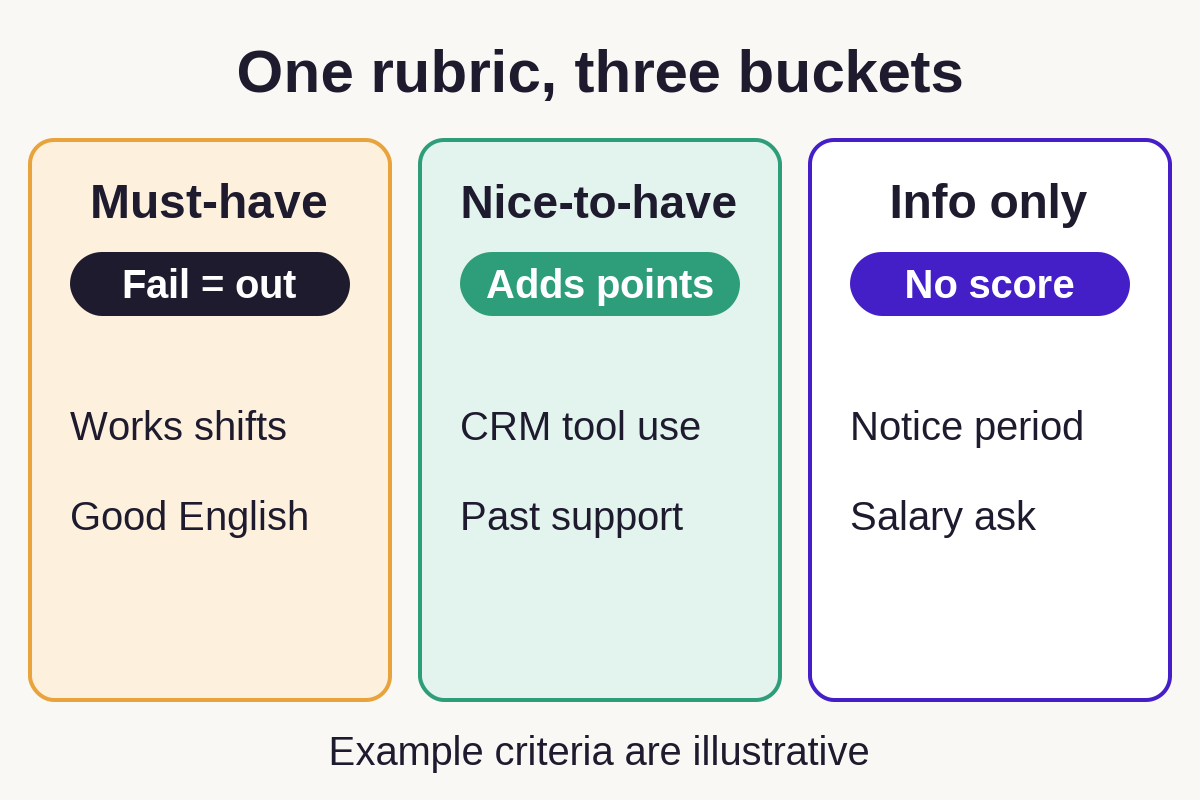
Sort every requirement into one of three buckets. Must-haves knock someone out, nice-to-haves add points, and information-only fields like notice period go to the recruiter without touching the score.
Get the hiring manager to agree to it on Monday, before you score anyone. Xquizit drafts the rubric from your job description and you edit the criteria, weights and gates. If the role changes mid-drive, update the rubric and reassess the candidates.
Let each stage drop people on evidence
Cheap checks first, expensive ones last.
Order the stages by what they cost you. The cheapest question is whether someone still wants the job. In Xquizit you can run one of these stages or all of them, and the candidate's profile moves between them without a fresh upload.
Ask before you read
A short WhatsApp or phone check covers interest, location, notice period and availability. Phone screening runs in English or Hindi.
Read resumes against the rubric
Xquizit screens resumes in bulk and marks each requirement as explicit, inferred or missing. Missing means you ask about it next; it doesn't prove the person can't do it.
Let them show the work
Send a short skill test or AI interview with a deadline, and candidates take it in parallel when it suits them. The AI interviewer follows up on answers and checks claims against the resume, so nobody books 200 phone calls.

Cap the list, then read behind the top scores
The last 40 names are yours.
Set the cutoff yourself. Xquizit can move people to the next round once they clear a score you configure, but you choose the number.
Then read. Each report puts the scores next to the answers behind them, with transcripts and recordings wherever the session captured them. Disagree with a score? Override it. The final choice stays with you.
What we'd do
With 1,500 applications and a Friday deadline, I wouldn't try to read faster. I'd write the pass mark on Monday, let each stage drop people on evidence, and spend my own hours on the last 40 names and the answers behind them. Reading every resume yourself feels careful, but at this volume you end up skimming the last few hundred.
Sources and notes
The 1,500 applications, 40 seats, Friday deadline, funnel counts and rubric criteria are illustrative, not customer results or benchmarks. This post uses no external statistics.
Xquizit capabilities (rubric from the job description, editable gates and weights, WhatsApp and phone screening, bulk resume screening, skill tests, AI interviews, score thresholds, evidence reports and recruiter override): Xquizit features. Further product documentation is available on request.
See a shortlist built on evidence.
Latest insights
View all insights →
Why Candidates Skip Your Online Interview (and 5 Fixes)
By Xquizit
Most no-shows come from the process. Contact candidates the day they apply, give a deadline instead of a fixed slot and answer their questions early.
Read insight
How to Run a Campus Drive Online Without the Chaos
By Xquizit
Run it as one pipeline: one test window for every college, interviews by a deadline instead of slots, and a person reviewing each borderline student.
Read insight
Is Your English-Only Screen Costing You Your Best Hires?
By Xquizit
If the job is not done in English, yes. Interview candidates in the language the work uses and score everyone on one rubric.
Read insight© 2026 Xquizit. All rights reserved | ALGO ONE AI PRIVATE LIMITED