Hiring
AI Interviews vs One-Way Video Interviews: Which Should You Use?
Recorded answers, AI follow-ups or a live conversation? Choose the format around the evidence your hiring team needs.
Author
Xquizit
Reading time
3 min read
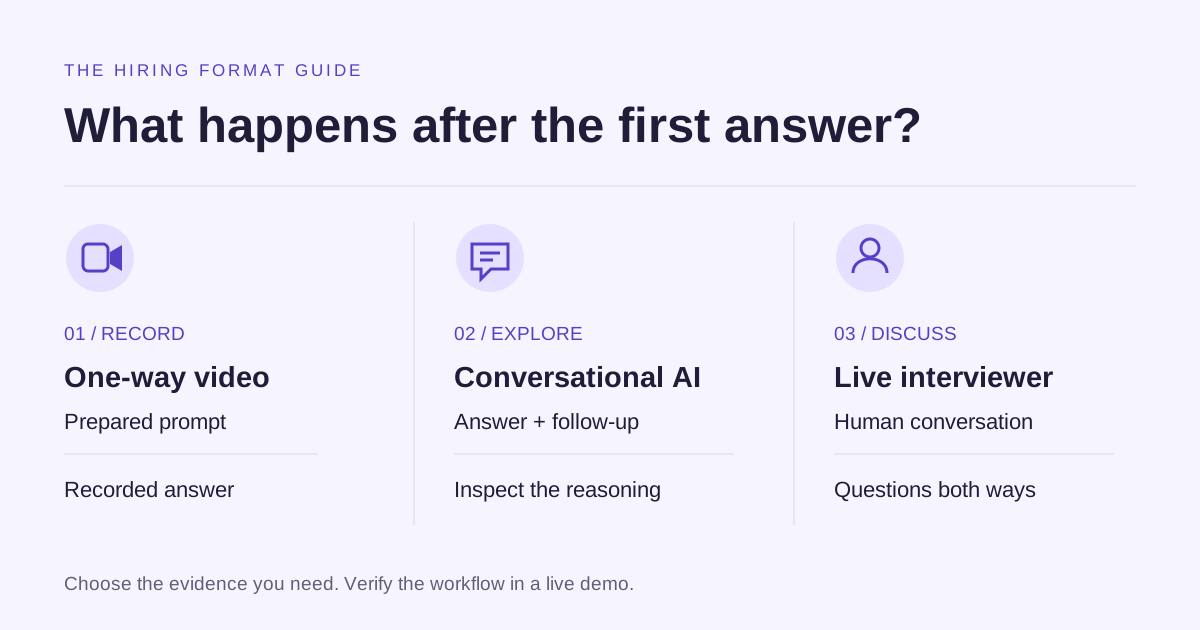
Choose one-way video for recorded responses, conversational AI when you need automated follow-ups, and a live interviewer when the discussion needs human judgement.
Buyer guide · part 2Same camera. Different interview.
Recording, questioning and scoring are separate capabilities. Check each one.
- Record
One-way video
Candidates record responses to prepared prompts. Reviewers watch later. Useful when you want a consistent set of opening answers without arranging a shared time. Check whether follow-ups require another round.
- Explore
Conversational AI
Here, this means software that asks follow-up questions during the session. Consider it when an opening answer needs probing. An AI label alone does not establish this capability; some tools only transcribe or score recordings.
- Discuss
Live interviewer
A person speaks with the candidate in real time. Consider this for complex trade-offs, candidate questions and a two-way discussion of the role. Allow for scheduling and interviewer time.
Try one answer in all three formats.
Watch what happens after the candidate's first response.
“I'd refund
the customer.”
Ask how the candidate would handle a delayed order. The opening answer sounds decisive, but leaves out the order status, refund authority and customer expectations.
Illustrative task, not a customer resultOne-wayReview the recorded answer against the prepared rubric.Conversational AITest whether it asks what the candidate would check before offering a refund.Live interviewerExplore the reasoning, then let the candidate ask about the team's policy.Define the job-related criteria first: information gathering, policy judgement and clear communication. Agree on acceptable probes and scoring anchors. Different follow-ups should not quietly become different standards.
Check the experience, not the label.
Ask each vendor to demonstrate its current capabilities.
Who asks the next question?
Give an incomplete answer. Does the tool probe it, repeat a script or stop? Check how recruiters control the question scope.
What can a reviewer inspect?
Request the answer, relevant transcript or recording, scoring criteria and rationale. Check how a recruiter challenges an automated result.
Can candidates complete it?
Verify supported devices and browsers, accessibility needs, interruption recovery and support contact options for the selected mode. Do not assume mobile or full proctoring support.
What work remains?
Count recording review, exception handling, candidate questions and final interviews. Automated questioning does not remove the need for recruiter judgement.
Sources and evaluation notes
Reviewed 3 November 2026. HireVue's one-way interview guide describes recorded responses to prepared prompts. Its dated device instructions are not used here. OPM's structured-interview guidance supports job-related questions and consistent rating criteria. These sources do not endorse Xquizit.
Xquizit's public feature overview describes conversational interviews with follow-ups. Ask to see the current workflow on your role. This guide does not claim that every vendor offers all three formats or that any format guarantees a better hire.
See the follow-up, not just the score.
Latest insights
View all insights →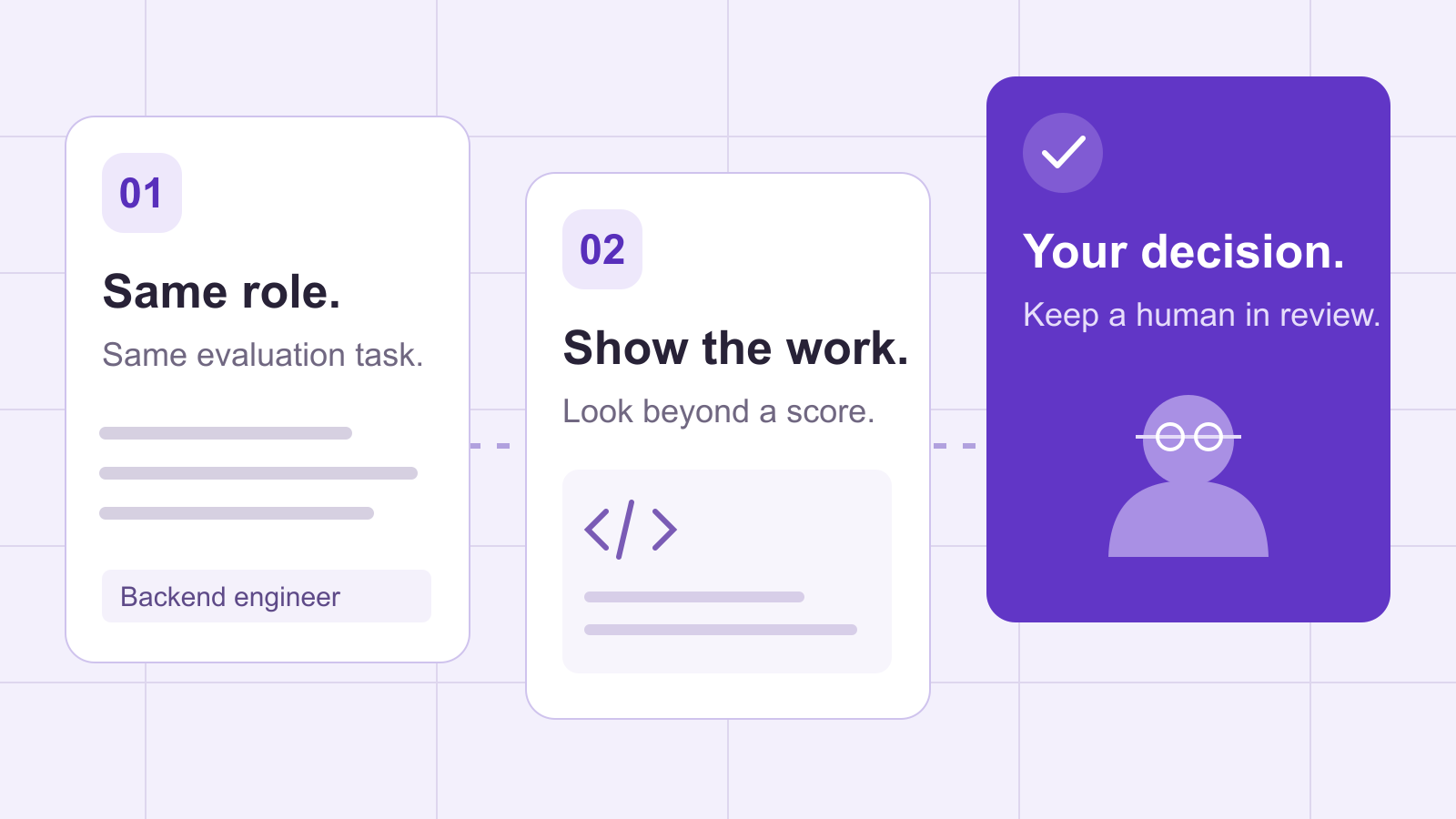
How to Choose AI Interview Software for Technical Hiring
By Xquizit
One role. Five checks. A clear cost. A quick visual guide for hiring teams.
Read insight
The Interview Is the Last Place You Should Be Evaluating Someone
By Nandini Vashistha
Interviews were never meant to verify resumes and skills. When earlier stages do that work, hiring managers finally get to evaluate the person - not prove they belong in the room.
Read insight
Imagine If the Olympics Worked Like Hiring
By Nandini Vashistha
Resumes are training history, not the race. Fair hiring means the same rules, the same track, and evidence of who can actually do the job.
Read insight© 2026 Xquizit. All rights reserved | ALGO ONE AI PRIVATE LIMITED